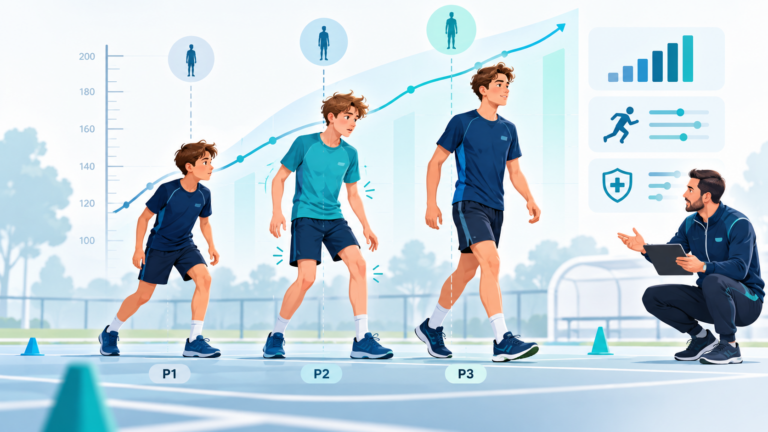

With a well-prepared measuring session you can measure a whole team in about half an hour. Schedule it a few times per season, for example at the start of the season, after the winter break and before the summer.
Preparation
- Make sure all players are in the growth calculation with their date of birth and sex.
- Inform parents in advance about the measuring session and why you are measuring.
- Arrange a quiet room, such as a changing room, with a flat wall.
- Bring a measuring rod, a stool with a hard seat, scales and a small board.
- Ask a second adult to help.
During the measurements
Measuring set-up in a changing room
Work in a fixed order: first height, then sitting height, then weight. Have one person measure while the other writes down the values or enters them directly on a tablet or phone. Measure without shoes and in light clothing.
Preferably measure at the start of training, before any jumping or running. Children are slightly shorter after exercise and at the end of the day.
Privacy and atmosphere
Height, and weight in particular, are sensitive for some children. Measure each child individually, not in front of the whole group. Do not say numbers out loud and do not compare players. The results are for the coach and, if they have access, for the parents.
After the measurements
The team overview immediately shows who is in which growth period and how far each player is from the peak of the growth spurt. Use this to adjust training: players in P2, for example, get less jumping and landing work and more attention to technique and recovery. The do’s and don’ts for each phase can be found in the player’s profile.
Tip
Put the next measuring date in the team schedule straight away. If you measure every three to four months, you will see the growth spurt coming and can adjust in time.
- Stewart, A., Marfell-Jones, M., Olds, T. & de Ridder, H. (2011). International Standards for Anthropometric Assessment. ISAK. Voor de manier van meten.
- Cumming e.a. (2017). Bio-banding in sport. Strength & Conditioning Journal, 39(2), 34–47. Voor de reden dat zithoogte en beenlengte in de formule zitten.